Course Overview: Food Safety & Hygiene Level 2 for Manufacturing
As a business owner or food handler, you have a duty to comply with the provisions of Regulation (EC) 852/2004 of the European Parliament on the Hygiene of Foodstuffs, the Food Safety Act 1990, and Food Hygiene (England) Regulations 2005. This requires Food Businesses to ensure that any staff working in food processing, manufacturing or food storage and packaging are supervised, instructed and trained in food hygiene and food safety in a way that is appropriate to the work they do.
This e-learning course was designed for food manufacturers to comply with the latest food manufacturing industry legislation and their legal obligation to ensure that food is handled, prepared and stored hygienically through safe preservation, packaging and transportation.
- RoSPA assured course
- Award winning elearning provider
- Basic to advanced training courses
- Quick and affordable
- Instant access with an instant digital certificate
Who needs a food hygiene certificate?
This food hygiene level 2 course is a self-study module (formerly known as Foundation Food Hygiene or Basic Food Hygiene) and maps to Industry Standards in food safety and hygiene as published by Improve Ltd, the Sector Skills Council for the Food and Drink Manufacturing Industry in the UK.
This food safety course will benefit anyone working in food processing, manufacturing, food assembly, packing and food storage. It allows every manufacturing business, regardless of size, to provide all staff with first class training at a fraction of the cost and disruption of classroom based training.
RoSPA Assured Training for Food Hygiene and Safety Level 2
Upon completion of this online food safety e-learning course learners will sit an online training test and when completed successfully will receive a RoSPA assured certificate in Food Hygiene and Safety for caterers, meeting the legal training requirements for catering and hospitality professionals who may prepare, cook, or handle food.
This course is not a formal RQF food safety and hygiene qualification, the levels only indicate the type of course so that businesses can choose whom it is suitable for.
- Objectives
-
What will you learn?:
- An introduction to Food Safety and Hygiene - Food Safety and Hygiene are terms commonly used when discussing industry practise and legislation, in this module we look at how they relate to processed or manufactured food.
- The Effect of Food-Borne Illness - looking at what food-bourne illnesses are and how they may impact us.
- Food Law - From growing, harvesting, delivery, preparation and right through to being eaten, food often has a long process to its journey and lots of opportunities for hazards such as contamination to occur. This module reflects legislation for food safety and hygiene.
- Hazards and Contamination - exploring food safety hazards and how they arise or how they may be prevented and controlled.
- Food Preservation, Food Storage and Temperature Control - This module covers how manufacturers preserve food safely, including appropriate storage and temperature controls.
- Personal Hygiene - this section looks at why personal hygiene is so important when working with food hygiene. From hand washing, health, first aid, protective clothing and appearance.
- Hygienic Premises and Equipment - this section looks at what part the premises and equipment design play in maintaining hygienic, pest-free conditions for food manufacturers.
- Hazards Analysis and Critical Control Point (HACCP) - it is a requirement of regulations that all businesses implement and maintain a documented Food Safety Management system based on HACCP. This section looks at what this involves.
- Certification and Duration
-
We offer two certificate options for our Level 2 Food Hygiene and Safety Courses. You can choose either the self-printed certificate which you may print a digital food safety and hygiene certificate immediately on completion of your course, or you may choose the option of a high quality posted certificate. For posted certificates, if completed successfully before 12:00 midnight, your food safety and hygiene certificate will be posted the next working day.
The training and test usually take between 2 to 3 hours to complete (depending on learning speed). This is equivalent to 6 hours face-to-face group training.
Learners are required to achieve a 75% pass mark to successfully complete the course. If necessary, the learner may attempt the test 3 times at no extra cost, having revisited the training material. If learners have not achieved the 75% pass mark, further attempts may be given by contacting Learner Support.
How it Works
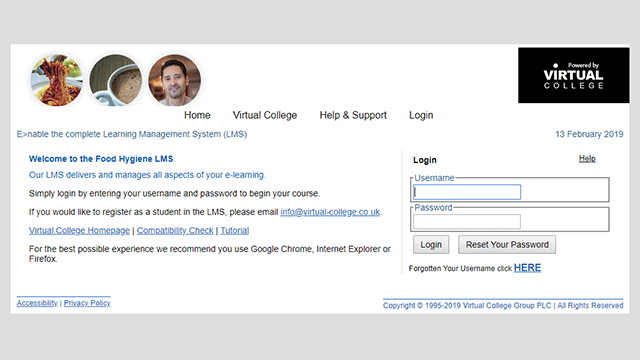
This is a general guide to how the learning management system works.
This is an online course, all the training will be taken through your browser window. There will be no face-to-face sessions with instructors nor will you receive any training material through the post.
If you wish you may print out any page of the training material and may also print the notes you took during the training. You can also revisit the training material at any time, even after you have completed the course.
The material for this course has been broken down into several smaller lessons, each lesson dealing with a specific area of the overall subject.
The lesson consists of a series of pages in which an instructor will talk you through the lesson material at a pace that suits you. Pages may also include supporting pictures, graphs, animation or extra sounds to help with the learning where appropriate. Some lessons will include challenges/quizzes to help you keep in touch and interested in the material.
Lessons can be taken in any order and each lesson may be PAUSED and RESUMED at any stage. When all lessons in the course have been completed our system will realise and automatically record that you have successfully completed the course.
The course is self-paced so you decide how fast or slow the training goes. You can complete the course in stages revisiting the training at any time, however the training and test usually take between 2 to 3 hours to complete, depending on learning speed.
Learners are required to achieve a 75% pass mark to successfully complete the course. If necessary, the learner may attempt the test 3 times at no extra cost, having revisited the training material. If learners have not achieved the 75% pass mark, further attempts may be given by contacting Learner Support.